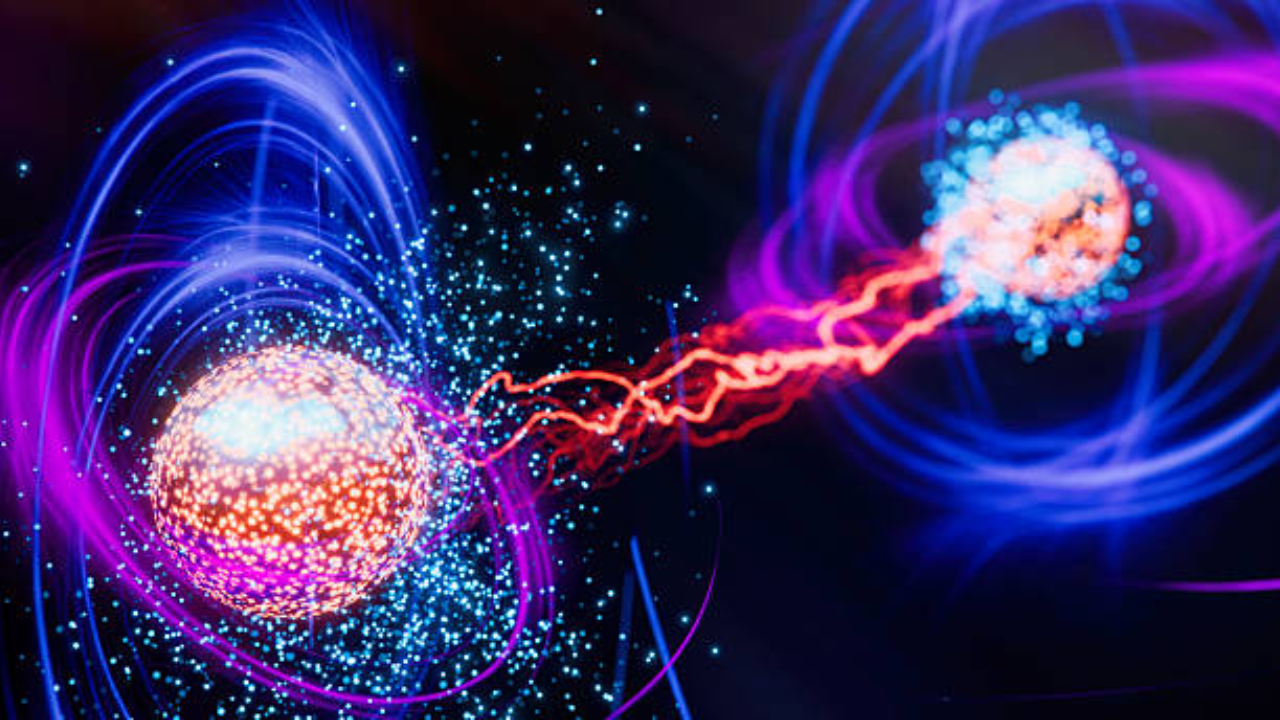
Albert Einstein hated quantum entanglement. He called it spooky action at a distance because it implied that two particles could stay connected across vast spans of space, instantly influencing one another without any physical signal passing between them. He thought it broke the rules of reality.
He was wrong.
Decades of experiments have proven him wrong at microscopic scales and low energies. But scientists at CERN just took things a step further. Physicists working with the ATLAS and CMS detectors at the Large Hadron Collider found strong evidence that heavy Z bosons can become quantum-entangled. This test happened in the most extreme, high-energy particle collisions humans have ever created.
If you thought quantum weirdness only happens in quiet, ultra-cold laboratory vacuums, think again.
Breaking Down How Z Bosons Get Tangled
Let's look at how physicists pulled this off. You can't just catch a Z boson in a jar. These particles are massive, fundamental carriers of the weak nuclear force, and they decay almost instantly after popping into existence. They live for a tiny fraction of a second.
To study them, researchers looked at Higgs boson decays. Specifically, they analyzed events where a Higgs boson breaks down into a pair of Z bosons, written in physics shorthand as H to ZZ*. Those Z bosons then decay into leptons, like electrons or muons, which particle detectors can actually track.
Because the parent Higgs boson has zero spin, the two child Z bosons must inherit properties that balance out. Their combined quantum states get locked together. By working backward from the decay debris hitting the sensors, scientists reconstructed the original spin correlations of the Z boson pair.
The results came in with a statistical significance of 4.7 standard deviations. That sits just below the strict 5-sigma threshold required to claim an absolute discovery, but it firmly qualifies as strong evidence under standard particle physics rules. The separable hypothesis—meaning the particles act independently—took a direct hit.
Why This Extreme Test Actually Matters
Most quantum entanglement tests happen in cozy setups using photons or low-energy atoms. Putting the concept through a crucible like the Large Hadron Collider changes the game.
The LHC smashes protons together at close to the speed of light. The energies involved are staggering. Proving that fragile quantum correlations survive inside this kind of particle storm tells us something fundamental about nature. It means quantum mechanics doesn't break down just because things get hot, heavy, and chaotic.
We've seen similar work with top quarks, which are the heaviest known fundamental particles. Extending these measurements to massive vector bosons like the Z boson proves that quantum entanglement is a universal feature of the Standard Model. It operates across the entire electroweak scale, no matter how violent the environment gets.
What Comes Next for Subatomic Physics
The real fun begins when the machinery gets an upgrade. CERN is currently preparing for the High-Luminosity Large Hadron Collider, often called the HiLumi LHC.
This hardware upgrade will pump up collision rates dramatically. More collisions mean massive datasets. With higher statistics, physicists can stop treating entanglement as a neat trick to confirm and start using it as a diagnostic tool. They can probe the inner workings of the weak force and search for tiny deviations that might point toward physics beyond our current textbooks.
Einstein spent his later years trying to prove that quantum mechanics was incomplete. Modern particle accelerators are using his exact skeptical legacy to push our understanding of the universe into uncharted territory.
Next time you look at the subatomic world, remember that distance and energy don't break the rules. They just make the physics more interesting.