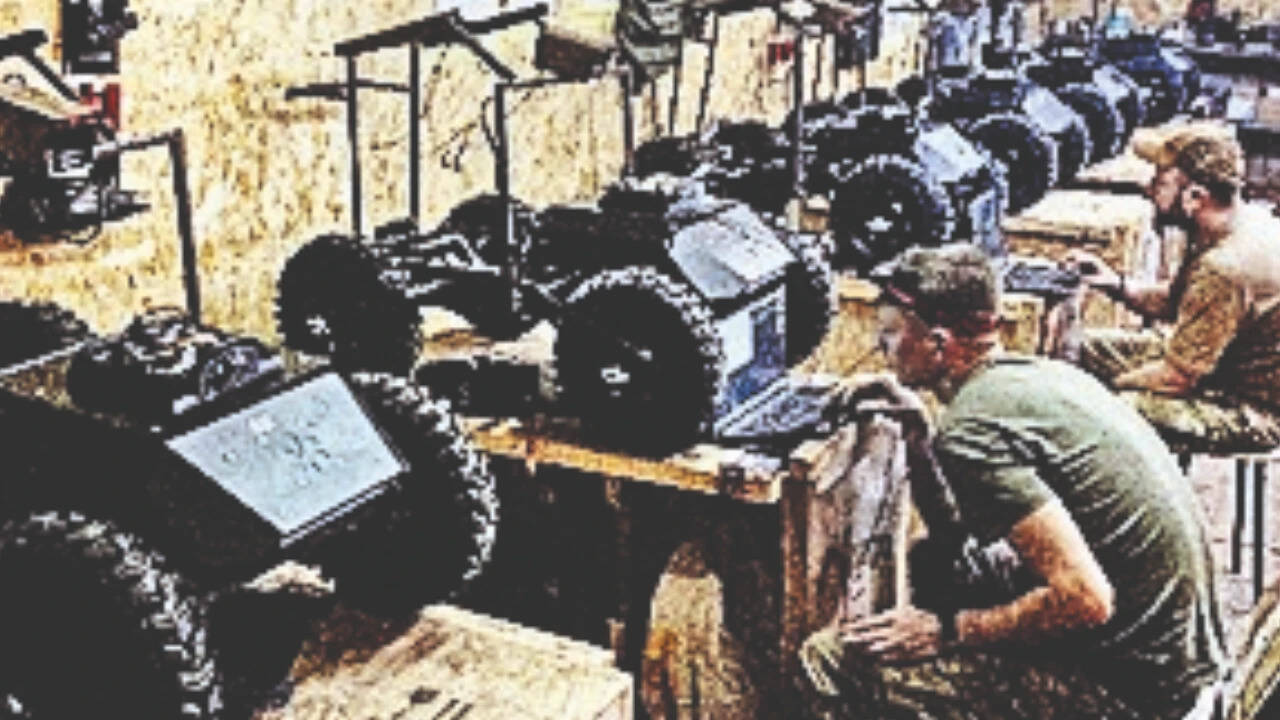
Step into a makeshift repair garage near the northeastern front lines of Ukraine, and you'll spot rows of compact, tracked, and wheeled mechanical units lined up against concrete walls. These aren't prototype lab toys. They're unmanned ground vehicles—widely called ground drones—hauling heavy explosive payloads directly into active combat zones. Military mechanics like the ones in the Third Army Corps spend their days tweaking circuits, programming logic, and welding metal racks onto these chassis to prep them for hazardous missions. Infantrymen used to walk these routes manually under continuous enemy surveillance. Now, machines take the hit instead.
Why are armies shifting away from human boots on the ground? Survival calculus drives the change. With aerial sensors blanketing the skies and artillery locking onto any sign of movement, standard infantry deployments face staggering casualties. Sending a 20-kilogram explosive payload on a remote-controlled tracked vehicle to blow up an enemy dugout makes tactical and humanitarian sense. You save a soldier's life, and you still complete the mission.
Units like the NC13 command center in the Kharkiv region run remote operations on a daily basis. Operators sit safely behind monitors with controllers in their hands, steering small mechanical mules loaded with anti-tank mines or machine-gun mounts right up to contested bridges and trenches. The math is simple. If a ground drone gets blown to pieces by a mortar shell, you lose metal and microchips. If a soldier takes that hit, you lose a person.
Commanders like Brigadier General Andrii Biletskyi view this automation wave as a fundamental shift in modern combat. The ambition for elite formations isn't small. They aim to swap out roughly one-third of active frontline infantry personnel with ground-based robotic systems. Critics might call it sci-fi creep, but frontline realities force rapid adaptation. When aerial threats make 90 percent of traditional infantry tasks suicidal, armies either automate or bleed out.
Critics often wonder if remote machines can truly replace human intuition during chaotic firefights. The answer right now is no, they can't. Ground drones get stuck in deep mud, throw tracks on jagged rebar, and lose signal behind concrete ruins. Remote operators still fight a constant battle against signal jamming and battery limits. But perfection isn't the standard on an active front. Good enough to clear a minefield or suppress a sniper without risking a human life is more than enough to change the outcome of a skirmish.
If you look closely at how military hardware evolves, ground robotics are following the exact path aerial quadcopters took a few years back. They started as fragile hobbyist toys strapped with minor grenades, then quickly matured into standardized industrial-scale tools of war. Workshops in abandoned warehouses across eastern Europe now churn out customized variations—some rigged with fire-suppression hoses, others modified with rocket launchers.
Warfare rewards adaptation speed, and the side that iterates fastest survives. Expect to see ground automation move from specialized elite units down to standard platoon levels over the coming years. If you're tracking where defense tech is heading, watch the workshops on the industrial fringes, not the sterile corporate boardrooms.