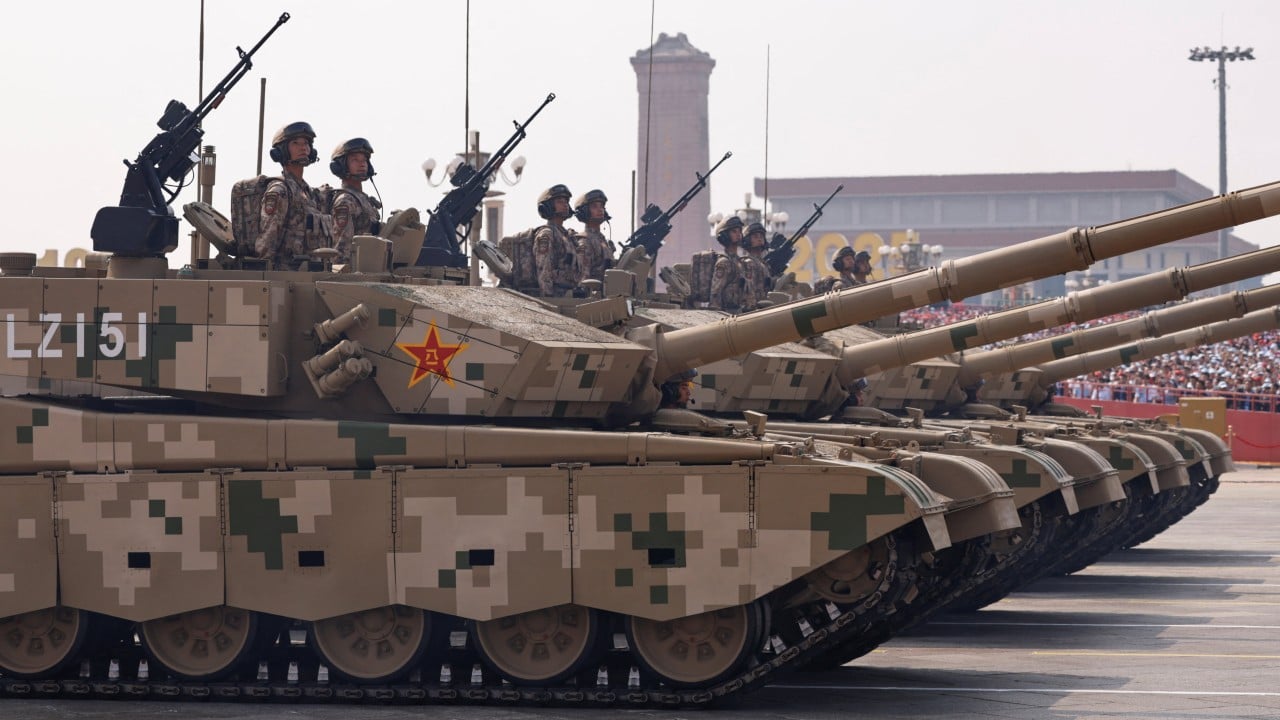
A battle tank that packs a nuclear reactor and fires a projectile 450 kilometers sounds like pure science fiction. Honestly, it reads like a rejected pitch from a dystopian Hollywood script. Yet, Chinese military researchers have published a serious, peer-reviewed engineering roadmap detailing just that.
Published in the Chinese journal Acta Armamentarii, the proposal comes from teams at the Inner Mongolia First Machinery Group and the Beijing Institute of Technology. It outlines a blueprint for a 60-tonne main battle tank fueled by a small modular nuclear reactor and armed with a heavy-duty electromagnetic railgun. If you think traditional tanks are complex, this concept takes military engineering into uncharted territory.
The Core Concept of the Nuclear Railgun Tank
Let's look at the raw specifications. The proposal relies on a 10-megawatt-class small modular reactor (SMR) designed to fit into a remarkably tight two-cubic-meter space. This SMR would feed energy directly into an electromagnetic railgun capable of launching projectiles at speeds around 3.5 kilometers per second.
That extreme muzzle velocity translates to a theoretical firing range of roughly 450 kilometers. For context, that is further than the distance from London to Paris. Traditional smoothbore tank guns rely on chemical propellants that hit a physics-imposed velocity ceiling, usually maxing out muzzle speeds significantly lower. Railguns bypass chemical propellants entirely, using intense magnetic fields to hurl metal rounds downrange.
However, generating the power is only half the battle. Delivering that massive spike of electricity—measured at 50 megajoules for the final system—in a matter of milliseconds requires intense energy storage and management systems onboard a moving vehicle.
The Three-Stage Roadmap to 2045 and Beyond
Military planners aren't trying to build this nuclear monster tomorrow. Instead, they've laid out a pragmatic three-stage development plan stretching across the next two decades.
Phase One: Pre-2035 Integration
The first step focuses on putting electromagnetic weapons onto existing tank platforms using mature power plants. This initial 60-tonne concept features a 1,500-horsepower diesel generator backed by supercapacitors and flywheels. It targets a 10-megajoule electromagnetic gun with a 150-kilometer range, alongside basic electromagnetic armor.
Phase Two: 2035 to 2045 Evolution
Mid-term development scales up the weapon power to a 20-megajoule gun capable of striking targets at 300 kilometers. Power demands jump via a 2,000-horsepower diesel system, supported by roughly five tonnes of advanced energy storage, including solid-state batteries and intelligent microgrids.
Phase Three: Post-2045 Nuclear Leap
Only after 2045 do researchers intend to make the jump to the full nuclear-powered design. This phase introduces the 10-megawatt lead-bismuth-cooled reactor and the headline-grabbing 50-megajoule railgun system.
Why Real-World Physics Gets in the Way
It is one thing to draw up a neat simulation paper. Building it in reality is an entirely different story. Veteran military equipment experts have pointed out massive hurdles that make this concept hard to swallow.
First, weight and space constraints are brutal. A nuclear reactor needs heavy radiation shielding to protect any crew inside the vehicle. The proposal specifies that this shielding must weigh no more than three tonnes while fitting alongside cooling systems, power-conversion equipment, and the reactor core itself. Every single kilogram spent on nuclear infrastructure is a kilogram stolen from actual physical armor or ammunition storage.
Second, think about survivability on a modern battlefield dominated by loitering munitions, FPV drones, and advanced anti-tank guided missiles. Putting a functional nuclear reactor on a crewed frontline combat vehicle creates a catastrophic liability. If an enemy weapon pierces the hull, the consequences go far beyond a standard diesel fuel fire.
Finally, experts question the tactical necessity of a tank firing 450 kilometers away. Tanks are direct-fire support and maneuver assets designed to engage visible enemy forces on a localized frontline. Giving a tactical vehicle strategic-artillery-level range blurs the lines between armor divisions and long-range rocket artillery, raising questions about spotting, target acquisition, and command structures.
China's nuclear railgun tank remains a theoretical simulation exercise rather than an imminent battlefield threat. While it highlights Beijing's long-term defense ambitions in directed energy and miniaturized nuclear tech, bridging the gap between computer models and actual combat steel remains a monumental climb.
This video provides a visual breakdown of China's proposed roadmap and the engineering hurdles behind the nuclear railgun tank concept.