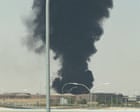
Thick black smoke rising near King Khalid International Airport isn't just a local emergency. It's a flashing neon sign that the fragile security architecture across the Arabian Peninsula is cracking under pressure. When the Saudi government pushed emergency air raid warnings directly to civilian phones overnight, citizens in Riyadh knew things had moved past the usual diplomatic posturing. Explosions echoed across the capital. Firefighters scrambled to contain flames tearing through an Aramco fuel storage facility.
If you've been tracking regional security, you know these escalations rarely happen in a vacuum. Let's look at what's actually driving this sudden spike in tension, why civil defense forces are on high alert from Jeddah to Yanbu, and what this means for global logistics and energy markets moving forward.
The Reality Behind the Riyadh Air Raid Alerts
For months, regional tensions simmered along predictable lines. But things shifted dramatically when fighting with the Iran-backed Houthis escalated. This weekend marked the first time authorities issued direct mobile air raid alerts for Riyadh since July. That matters. Governments don't panic-ping millions of smartphones unless the threat is immediate and visible.
Flight tracking data tells an equally grim story. FlightRadar24 flagged major disruptions at Riyadh's main aviation hub, placing the facility under its maximum disruption index. Travelers faced instant ground stops while airspace safety was reassessed.
- Emergency warnings triggered across Riyadh, Jeddah, and Yanbu.
- Visual confirmation of heavy black smoke near aviation and fuel infrastructure.
- Subsequent explosions reported hours after the initial all-clear signal.
Why Industrial Hubs Are Becoming Primary Targets
The strategy behind these recent strikes points directly at critical infrastructure. Striking near a major international airport and a prominent oil storage facility is designed to achieve maximum psychological and economic disruption. Yanbu, a massive industrial port city on the Red Sea coast, also received direct warnings.
When you target energy and transit nodes, you aren't just hitting concrete and steel. You're sending a message about vulnerability. The Houthis have steadily expanded their operational footprint, recently seizing control of strategic Red Sea islands like Greater and Lesser Hanish, alongside the port of Mokha near the Bab al-mandab strait.
This creates a terrifying chess match for global shipping lanes. Trade routes through these waters handle a staggering percentage of the world's energy supply. Any prolonged instability here ripples straight into fuel prices at pumps worldwide.
The Diplomatic Impasse and International Response
While smoke cleared over the Saudi capital, international bodies rushed to issue condemnations. The UN Security Council met and called for stricter enforcement of existing arms embargoes against the Houthis, pointing out that recent attacks have consistently injured civilians and targeted essential energy grids.
Yet, words from New York rarely stop incoming projectiles. Houthi military spokespersons fired back, blaming Riyadh for ongoing airstrikes and promising swift retaliation. Meanwhile, regional alliances are shifting behind closed doors. Reports of potential defense pacts involving neighboring states threaten to pull even more external military powers directly into the Yemeni conflict.
You're watching a localized civil war morph rapidly into an international crisis that defies easy diplomatic fixes.
What Comes Next for Regional Stability
Don't expect a quick de-escalation. The military calculus on both sides currently favors aggressive posture over compromise. Saudi civil defense teams remain on high alert, and urban residents are being told to avoid public gatherings.
If you track international risk or energy markets, keep your eyes on Red Sea shipping choke points and secondary industrial cities like Yanbu. The smoke over Riyadh isn't an isolated incident. It's the new baseline for a region hurtling toward deeper instability. Take practical steps to monitor route changes if you have business or travel connections to the Gulf right now, because the airspace situation remains volatile.