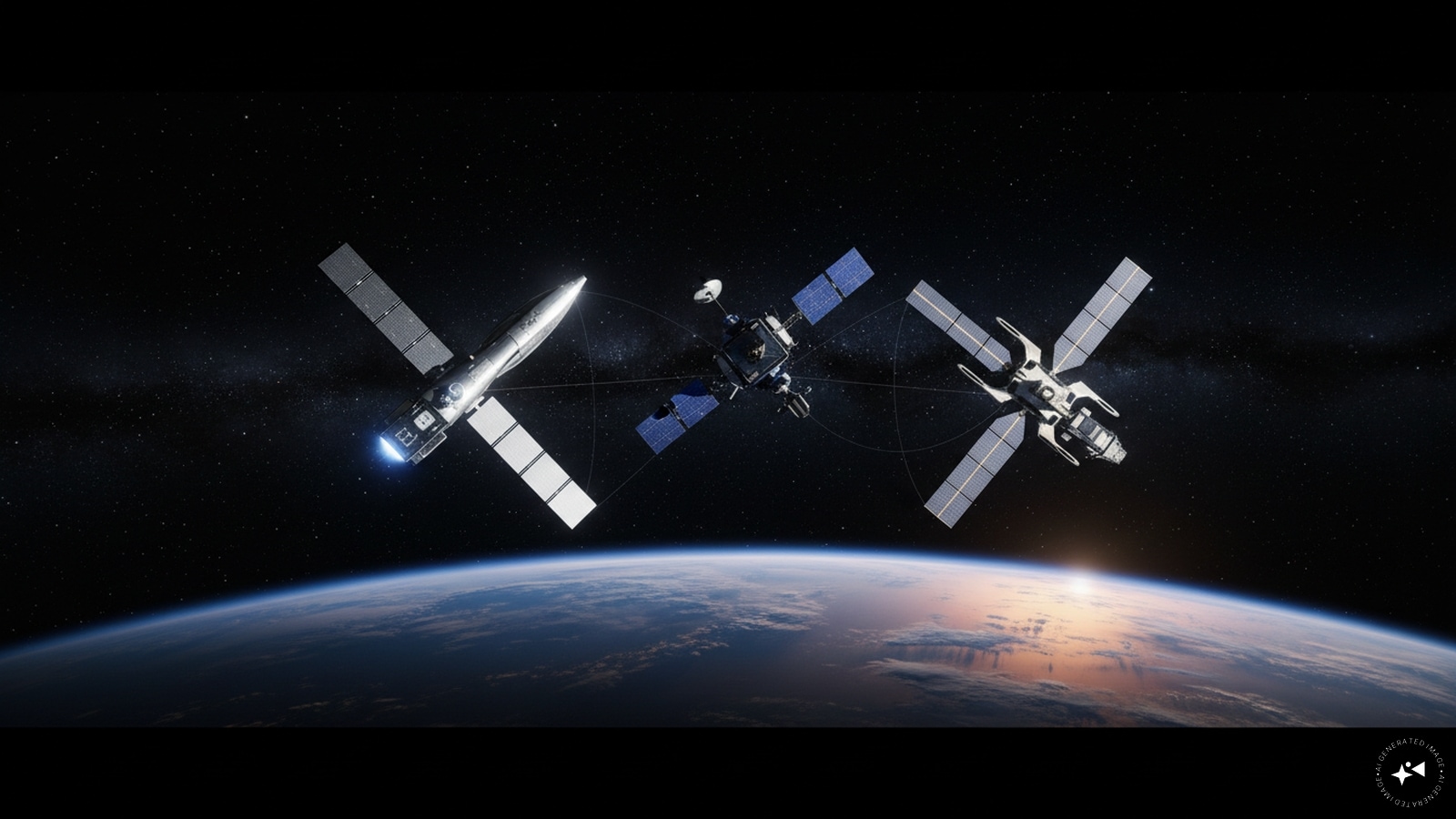
The United States just crossed a line it avoided for decades. Washington has officially confirmed that it has deployed offensive weapons into Earth's orbit.
For years, Pentagon officials pointed fingers at Beijing and Moscow, accusing them of testing anti-satellite lasers and orbital jammers. Now, the mask is off. Air Force Secretary Troy Meink stated publicly at the Air, Space and Cyber Conference that the U.S. Space Force fields "on-orbit space control weapons" meant to protect joint forces from hostile actions.
If you think space is still a peaceful frontier of science and communication, you're living in the past. Orbit is officially a warfighting domain.
What an Orbital Weapon Actually Means
Let's clear up the confusion right away. When people hear "space weapon," they picture orbital laser arrays blowing up cities or star wars dogfights. Reality is much quieter, and arguably more insidious.
Meink refused to provide specifics on the hardware, citing operational security. But defense analysts point out that kinetic weapons—missiles fired from space to hit targets on Earth or other satellites—create catastrophic debris fields. Nobody wants a cascading cloud of high-speed shrapnel destroying their own multi-billion-dollar infrastructure.
Instead, experts like Victoria Samson of the Secure World Foundation suggest these systems are likely non-kinetic. Think space-based electronic warfare equipment, high-powered jammers, or robotic grapplers designed to blind, deafen, or disable adversary spacecraft without shattering them into a million pieces. The Space Force itself describes its "space control" mission as using both kinetic and non-kinetic means to contest the domain.
Why Washington Broke Its Silence Now
Transparency in military tech is rarely an accident. Governments don't drop secrets at industry conferences unless they want a specific message sent.
The timing coincides with the push to build out space-based interceptors for the proposed "Golden Dome" missile defense architecture. More importantly, it is a direct signal to Russia and China. Washington spent years playing defense, complaining about rival satellites creeping close to American assets. By admitting they have skin in the game, the Trump administration wants to establish deterrence.
The logic is simple: if adversaries know the U.S. can retaliate directly in orbit, they might think twice before blinding a GPS or communications satellite during a conflict.
The Dangerous Downside of Going Public
Admitting to orbital strike capabilities might sound tough, but security analysts warn it could backfire.
When one superpower normalizes space weaponization publicly, the restraint barrier crumbles. Russia and China no longer have to hide their programs behind ambiguous research labels. They can point to the U.S. announcement as justification for expanding their own offensive arsenals.
We are looking down the barrel of an unconstrained orbital arms race. The 1967 Outer Space Treaty bans weapons of mass destruction in orbit, but it leaves a massive loophole for conventional weapons and electronic warfare systems. Nations are sprinting through that loophole right now.
Modern militaries rely entirely on space for navigation, banking, intelligence, and troop coordination. Once those assets become targets—and once active weapons sit directly above your head—the margin for error shrinks to zero.
Watch how Beijing and Moscow respond in the coming weeks. The militarization of the stars is no longer a theoretical debate. It is happening in real-time, and there is no turning back.