Moving a modern pontiff across international airspace isn't just a matter of booking first-class seats. When Pope Leo XIV touches down in France for his official visit, the operation relies on a massive logistical machine involving national carriers, state-level diplomatic clearances, and high-security protocols that few outsiders ever witness.
Planning a papal flight is a relentless puzzle. You're balancing strict security mandates from the Vatican's Gendarmerie with civil aviation authorities and domestic airline crews. Let's look at how these complex journeys actually come together behind closed doors.
The Air France Partnership and State-Level Status
Transporting the head of the Catholic Church requires more than standard commercial charter arrangements. For the September 2026 apostolic journey across France, Air France coordinates the specialized flights linking Paris-Orly, Lourdes, Metz, and eventually back to Rome-Fiumicino.
These aren't regular passenger runs. Every flight carrying Pope Leo XIV holds official state aircraft status. That designation changes everything in the cockpit and air traffic control centers. It guarantees absolute priority handling across European airspace, bypassing standard holding patterns and granting direct routing wherever possible.
More than a hundred airline employees—spanning flight operations, maintenance, security, catering, and ground coordination—spend weeks preparing every detail. For the flight crew selected to operate these legs, it's a career-defining moment. Captains and cabin personnel undergo rigorous background checks alongside specialized briefings regarding protocol and in-flight security.
Inside the Cabin and Cargo Hold
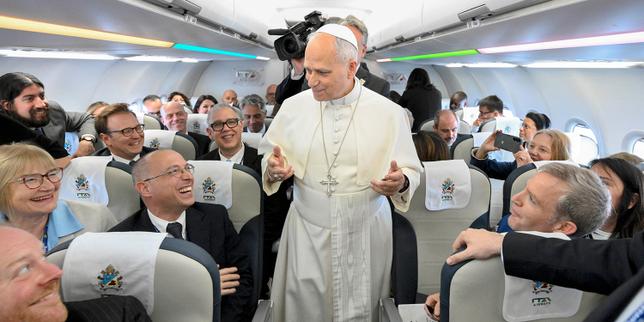
If you step aboard a papal transport aircraft, you won't find standard seating configurations. The cabin is partitioned to accommodate the Holy Father, his closest aides, medical personnel, and the travelling press corps. Seats feature specific diplomatic arrangements, often marked with the emblems of the Holy Saint-See.
Cargo holds tell an equally fascinating story. Beyond the pontiff's personal luggage and advanced speech drafts prepared weeks in advance, the aircraft hauls sealed metal chests. Inside these containers are heavy liturgical vestments—chasubles, mitres, and sacred vessels required for outdoor masses and cathedral services. You'll also find crates filled with official Vatican gifts: custom medals, blessed rosaries, and commemorative items designated for heads of state and local dignitaries.
A dedicated companion flight operated by Transavia often handles the overflow delegation, carrying cardinals, bishops, and international journalists who follow every movement of the tour. This dual-aircraft choreography keeps the entire entourage moving on a ruthless, down-to-the-minute schedule.
Historical Echoes in the Skies
Aviation partnerships with the Vatican carry decades of institutional memory. When airlines manage papal tours, they lean on a long-standing heritage. For instance, air carriers frequently honor historical milestones during these visits—such as commemorative archival posters tracing back to mid-century jubilees when carriers first began actively promoting spiritual pilgrimages.
These nods to aviation history remind crews that they're participating in a tradition stretching back through decades of papal transit, from vintage prop planes to modern widebody jets.
Managing the Ground and Air Interface
The logistical headache doesn't end when the wheels touch the tarmac. Coordinating motorcades, mobile staircases, and tarmac security cordons demands absolute precision between airport authorities and state police. On a tight multi-city itinerary—moving swiftly from the capital to Marian sanctuaries and industrial regions—any delay in the air cascades into a massive security nightmare on the ground.
That's why dispatchers build tight contingency windows into every flight plan. Weather shifts, air traffic congestion over major European hubs, and security sweeps are factored into every minute of the schedule before the engines ever start.
When you watch the white-clad figure step out onto the aircraft stairs, you're seeing the visible tip of an enormous, highly disciplined aviation operation that runs entirely out of sight.